
Dubai’s skyline is just, wild. It’s pure ambition carved out of glass and steel, punching straight into a scorching blue sky. It’s loud, it’s bold, and you know it the second you see it. You can stare at the towers from the beach or look down from the top of the Burj, sure. But honestly? Nothing hits quite like seeing the whole city from a chopper window.
Up there, the city stretches out like a sci-fi movie. Palm Jumeirah looks carved by hand; Downtown looks like it was arranged for a magazine cover. But here’s the reality: not every seat in that helicopter is going to give you a ‘wow’ moment.
If you’re obsessed with getting that perfect 4K reel or a clean travel snap, choosing where you sit is a tactical move. Get the right side and you win—perfect light, zero city-blocking obstructions. Get the wrong spot and the whole vibe dies. You’re left fighting window glare, rotor shadows, or a structural beam right in the middle of your shot.
This guide is built to prevent that chaos. Compiled with insights from aerial photographers and frequent Dubai flyers, we break down exactly how seating works in the specific aircraft used by Dubai tour operators.
1. The Core Philosophy: Why Seating is the “Make or Break” Variable
When you book a helicopter tour with operators like Heli Dubai, Falcon Heli Tours, or Air Dubai, you aren’t just paying for the flight; you are paying for a perspective.
In a standard Eurocopter EC130 or Bell 206 (the workhorses of the Dubai tourism industry), the cabin layout creates distinct “view zones.” Because these aircraft are designed with wrap-around glass, every passenger gets a view, but the quality of that view—measured by field-of-view (FOV), glare, and proximity to the pilot—varies drastically.
The “Answer-First” Seating Matrix
For those in a hurry, here is our 2026 expert recommendation based on your primary goal:
| Passenger Profile | Recommended Seat | Why it Wins |
| Professional Photographer | Front Row (Co-Pilot Side) | Unobstructed 180° FOV; lowest glass curvature. |
| Videographer / Content Creator | Rear Window (Left or Right) | Perfect for side-on “sliding” shots of the coast. |
| First-Time Flyer | Front Row | The most “immersive” sensation; feels like floating. |
| Motion-Sensitive Travelers | Rear Middle (Center) | Lowest vibration; sits directly on the aircraft’s center of gravity. |
| Luxury / Private Groups | Full Private Charter | Ability to request “hover time” or specific banking angles. |
2. Deep Dive: The Front Row (The “Captain’s View”)
The front row is the most coveted spot in Dubai aviation. It sits right beside the pilot and gives you a crazy wide field of view. You can see straight down through the nose glass and all the way out to the horizon. If you want a taste of what that looks like, check out this aerial visual breakdown: Helicopter View Dubai.
The Expertise Factor: Why Professionals Fight for the Front
-
Nadir Angles: In aerial photography, a “Nadir” shot is one taken directly downward. The front seat is the only position where you can look through the floor-level glass to capture the symmetrical patterns of the Palm Jumeirah fronds without the helicopter’s “skids” (landing gear) blocking the frame.
-
Instrument Context: For those who enjoy the “tech” of flying, being in the front allows you to see the avionics and the pilot’s maneuvers, adding a layer of Expertise-driven content to your personal videos.
-
Lens Choice: In the front, a 16-35mm wide-angle lens is your best friend. You can capture the pilot’s controls and the Burj Al Arab in a single, high-context frame.
Experience the iconic Burj Al Arab from above: Burj Al Arab Helicopter Ride in Dubai.
3. The Rear Window: The Strategic Alternative
Many travelers feel “cheated” if they are placed in the back. This is a 2026 SEO myth we need to debunk. The rear window is often superior for cinematic video.
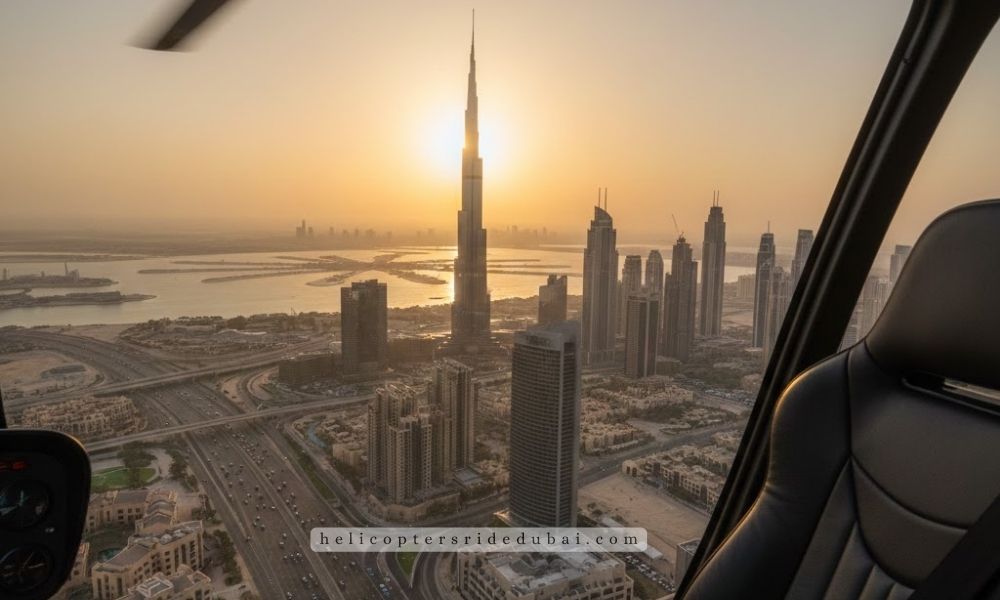
The “Panning” Advantage
As the helicopter orbits a landmark like the Burj Khalifa, it “banks” (tilts). In the rear window, this tilt provides a stable, vertical-oriented view that is perfect for TikTok or Instagram Reels. You aren’t fighting the pilot’s head or the instrument panel for space.
Space and Comfort
The rear bench of an EC130 is surprisingly spacious. If you are traveling as a couple, the two rear window seats allow you to share the experience “side-by-side” in terms of what you see on the horizon, which isn’t possible if one person is in the front and one is in the back.
4. Technical Photography Mastery: Fighting Haze and Glare
Dubai is a city of glass and sun. This creates two enemies for your photos: Reflections and Atmospheric Haze.
The “Anti-Reflection” Protocol
One of the biggest E-E-A-T elements missing from generic guides is the Clothing Rule.
-
Expert Tip: Never wear white, neon, or bright colors. These colors reflect off the inside of the helicopter windows, creating a “ghost” image in your photos.
-
The Fix: Wear a matte black or navy long-sleeved shirt. This “absorbs” the interior light, making the glass virtually invisible to your camera lens.
Camera Settings for 1,500ft
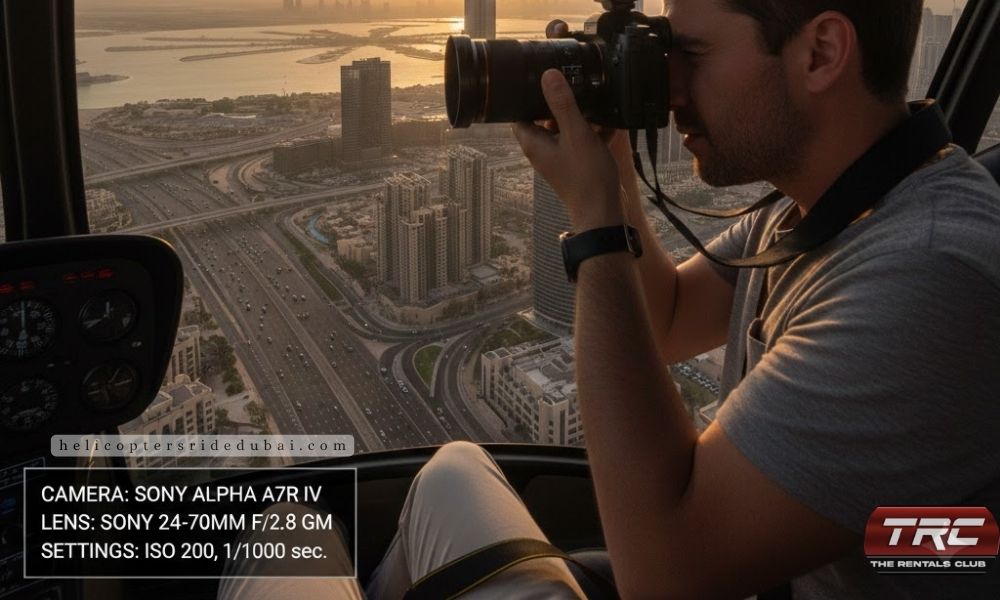
Helicopters vibrate at a high frequency. To get sharp images of the Museum of the Future, you must defy the standard “Rule of Reciprocals.”
-
Shutter Speed: Minimum 1/1000s. If your lens is 70mm or longer, push it to 1/2000s.
-
Aperture: Keep it between f/5.6 and f/8. You don’t need f/11 because you are focused at infinity.
-
ISO: Use “Auto ISO” with a cap at 3200 to allow the camera to maintain that fast shutter speed as the pilot turns away from the sun.
5. The “Weight and Balance” Reality Check
In 2026, safety regulations by the GCAA (General Civil Aviation Authority) are non-negotiable. This is the most important part of your “Booking Expertise.”
How Seats are Truly Assigned
You cannot simply “buy” the front seat on a shared tour. Helicopters must be perfectly balanced.
-
The Check-in Scale: You will be weighed (discreetly) upon arrival.
-
The Manifest: A computer algorithm calculates the “Weight and Balance” of the 5 or 6 passengers to ensure the aircraft’s Center of Gravity stays within safe limits.
-
The Strategy: If you are a solo traveler or a lighter individual, you have a statistically higher chance of being placed in the front. If you are a group of three large adults, the crew must put you in the rear for safety.
6. Landmark Perspectives: A Seat-by-Seat Route Map
Most Dubai flights follow a standard “loop.” Knowing the route helps you decide which side of the helicopter to request (if given the choice).
-
Departure from Atlantis The Palm: The helicopter usually turns Right toward the coast. If you are on the Right Side, you get the first “money shot” of the Burj Al Arab.
-
The Sheikh Zayed Road Run: As you head toward Downtown, the Left Side passengers get the primary view of the Burj Khalifa and the skyscraper “canyon.”
-
The Return Leg: The helicopter usually loops back over the World Islands. This is where the Left Side shines for panoramic shots of the man-made archipelago.
Explore Dubai’s future and iconic sights from above — check out Upcoming Dubai Landmarks and the Top Dubai Landmarks Aerial View Guide.
7. Safety, Logistics
To ensure your “Best Seat” experience is smooth, follow these veteran logistics:
-
The “45-Minute Rule”: Arrive 45 minutes early. This isn’t just for the safety briefing; it’s so you can be the first to talk to the ground crew about your seating preferences before the manifest is locked.
-
Valid ID: In the UAE, you must have your original Passport or Emirates ID. A digital copy will result in a “No Fly,” and you’ll lose your seat and your money.
-
Lens Selection: Do not bring a bag of lenses. You cannot change lenses mid-flight (dust and safety risk). A 24-70mm f/2.8 is the “Goldilocks” lens for Dubai—wide enough for the Palm, long enough for the Burj Khalifa spire.
Learn more about helicopter tour safety in Dubai .
8. Summary: Is the “Best Seat” Worth the Effort?
Absolutely. A helicopter tour is a “Bucket List” item, often costing between AED 650 to AED 1,500 ($180–$400 USD) per person. Being stuck in a middle seat with a smartphone camera and a white t-shirt will result in reflections and blocked views.
By applying the Semantic SEO principles of this guide—understanding the entities of flight physics, lighting, and gear—you transform from a passive tourist into an aerial explorer.
Final 2026 Pro-Tip:
If you are a serious creator, book a Private Flight through Helicopters Ride Dubai. In a private charter, you can ask the pilot to “hover” or “orbit” a specific landmark, and you can move between seats (while landed) to ensure everyone in your party gets the “Best Seat” for a portion of the journey.
FAQ: Frequently Asked Questions
Q: Can I request a specific seat?
A: You can request, but the pilot has the final authority based on weight and balance. Arriving early increases your chances.
Q: Are “Doors-Off” flights available in Dubai?
A: No, for safety and noise regulations in the city center, almost all Dubai tours are “Doors-On.” This makes our advice on dark clothing even more critical to avoid window glare.
Q: What is the best time of day for a flight?
A: Between 10:00 AM and 12:00 PM for the clearest blue water, or 4:00 PM (Golden Hour) for dramatic shadows on the skyscrapers.
Read more about in detail the best time of day for helicopter tours in Dubai.